Polish Roots #2: The Picture in the Lining
The old coat was still hanging in the closet. Anna hadn't expected that. Grey wool, too heavy for Vancouver weather, smelling of mothballs and of something unfamiliar. Beneath it, on the shelf, sat a tin box that had once held Christmas cookies.
Inside: family photographs with scalloped edges, a rosary, a Monte Cassino Cross on a faded ribbon. And a small holy picture, worn as soft as cloth — Our Lady of Ostra Brama, her face almost rubbed away by fingers. Something was folded inside the picture. A sheet of paper, brown ink, Grandma's birth certificate with the stamp of some parish: born 1936, Nowogródek.
On the back of the picture, in pencil, two words: Krasnowodsk 1942.
Grandma Zofia never spoke about the war. "We came from far away," she would say quietly, and drift off into her thoughts.
The dog had been barking for a while before someone struck the door with a rifle butt.
Helena, Zosia's mother, could never afterwards remember the soldiers' faces. Only the beam of a flashlight on the wall and the shout that they had one hour. Józef wasn't there — they had taken him back in the autumn, and no word had come since. His mother was tying rusks into a shawl, her hands shaking so badly that the knot wouldn't hold. Zosia stood in the middle of the room wearing three dresses at once. Bread. Flour. A featherbed. A sheepskin coat.
The picture, with the parish paper folded inside it, vanished into a torn pocket of the coat, deep under the lining, before the soldier could turn around.
It was February 1940. The frost was so hard that the snow squealed under the sleigh runners all the way to the railway station.
The train had been standing for three days. On the other side of the wagon wall someone was quietly counting the dead.
Helena pulled a thread from the hem of her dress and, by feel, stitch by stitch, sewed up the hole in the pocket. Zosia slept in her lap. Only the two of them knew what was in there.
In the forest settlement, bread was measured in grams and work in cubic meters of timber. Józef's mother lasted until the second winter. The ground froze like iron — they could not dig the grave until spring.
The night before the funeral, Helena unpicked the stitches for the first time. There was no priest. She held the picture over the dead woman's face and recited the litany from memory, and Zosia gave the responses, just as she had heard them in church in Nowogródek. Then Helena sewed the lining shut again.
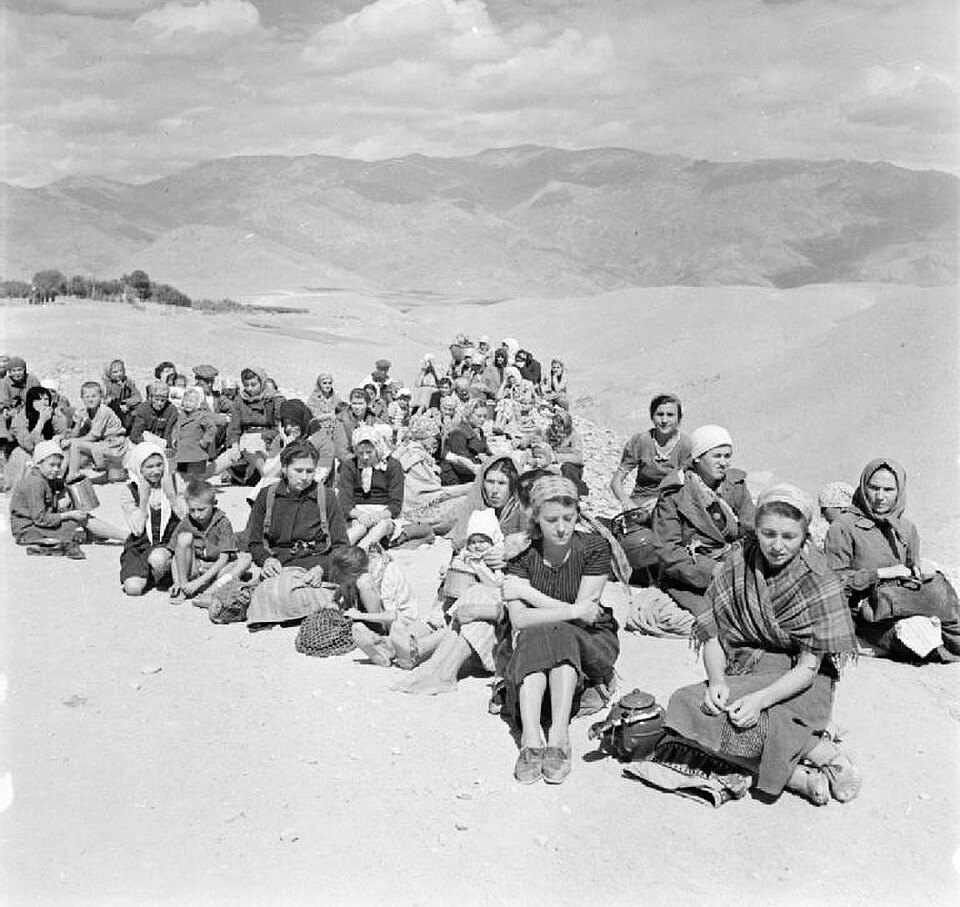
The word "amnesty" came in late summer 1941. They walked hundreds of kilometers, then rode freight trains and barges, south, toward the Polish army, toward anyone at all who would speak to them in Polish. At stops along the tracks, those who no longer had the strength to climb back aboard were left behind.
In the snow by an army camp, a soldier pressed a piece of bread into Zosia's hands — real bread, heavy and fragrant. She didn't eat it all. She hid it under her coat, so there would be something tomorrow too.
The ship at Krasnovodsk was so crowded there was nowhere to sit. Zosia counted the waves so she wouldn't be sick. All the way across, Helena clutched the lining of the coat in her fist.
In Iran there was sand, and sea, and no guards.
That night Helena couldn't sleep. Under the stars she unpicked the stitch for the second time. She took out the picture, licked the stub of a pencil someone had given her on the ship, and on the back she wrote the name of the port they had sailed from. Then she lay down beside her daughter and, for the first time in two and a half years, slept through the night.
Then: Africa. A school under a grass roof. A letter from Józef in Italy, the first in three years. A ship to Halifax. The first Canadian winter. A new life in a strange world. Zosia grew up and married. She never wore the grey coat again, but she would not let anyone throw it away.
Anna sat on the floor with the picture in her palm. Only now did she remember what Grandma Zosia had once said, very old by then, mixing up names and years: "Mama said that over there, in Iran, the night ended."
She ran her finger along the lining of the grey coat and found them — a row of small, uneven stitches, made in the dark eighty-six years ago, unpicked on one side, around a pocket that held nothing anymore.
Later she learned that the paper might mean more today than anyone had imagined — for her children, too. But that is another story.
A fictional story set against real events.