Which documents do you need to confirm Polish citizenship?
The most common question we hear at the start of working together is: “Do I have enough documents?” The good news is that nobody starts with a complete set. Below we explain what you need to prove, which documents most often make that possible, and where to look for missing ones.
What exactly do you need to prove?
In an application for confirmation of citizenship you need to show two things:
- Your ancestor's citizenship — that the person you derive your right from was a Polish citizen and did not lose that citizenship before their child was born, nor — before 1951 — while the child was still a minor.
- Descent (filiation) — an unbroken chain of civil-status records from that ancestor to you.
A lack of documents in one of these areas does not mean the case is impossible. It only means they need to be found or replaced with other evidence.
Documents proving your ancestor's citizenship
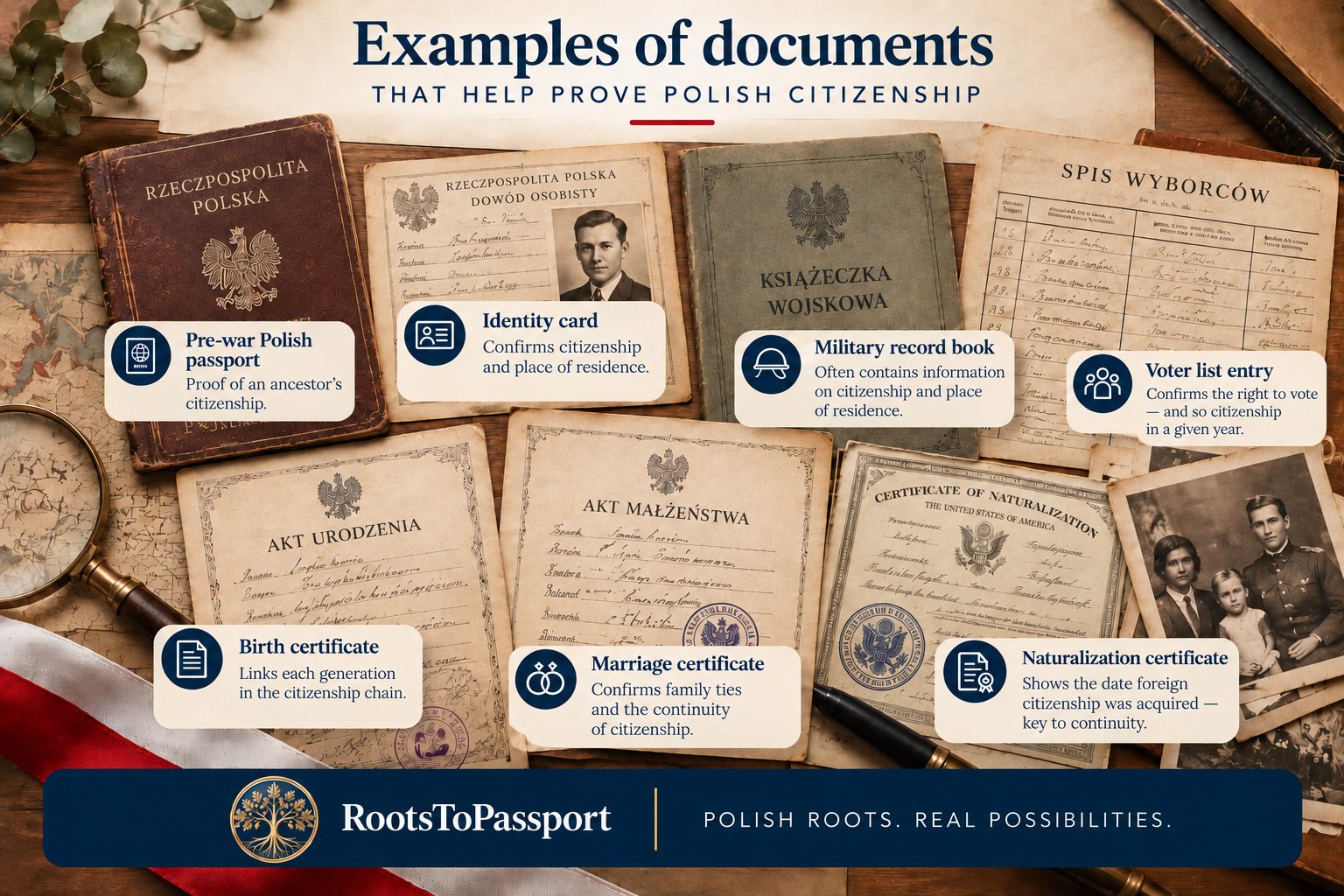
The strongest are documents issued by the Polish authorities that show citizenship directly:
- a pre-war Polish passport (even expired or damaged),
- a Polish identity card,
- a military record book or conscription documents,
- an entry in the permanent population register or residents' register,
- an entry in a voter list — the right to vote was reserved for Polish citizens,
- certificates from Polish consulates, e.g. of a citizen's registration abroad.
Foreign documents in which the ancestor is listed as a Polish citizen can also help: ship passenger lists, naturalization applications and certificates, alien registration cards or censuses. The naturalization certificate matters for one more reason — it shows the date foreign citizenship was acquired, and that date determines whether Polish citizenship passed to the next generation.
Documents proving descent
- your birth certificate,
- the birth and marriage certificates of your parents, grandparents and earlier ancestors in the line through which you claim citizenship,
- documents of any change of first name or surname, if the spelling changed after emigration (a very common situation).
Records issued abroad usually need an apostille and a sworn translation into Polish. We take care of this as part of handling your case.
Where to look for missing documents?
In Poland
- Civil registry offices (USC) — birth, marriage and death records from the last 100 years (births) or 80 years (marriages and deaths).
- State archives — older parish and civil registers and population records. Many holdings can be searched at szukajwarchiwach.gov.pl.
- Archive of Records from Beyond the Bug River (Archiwum Akt Zabużańskich) — registers from the former Eastern Borderlands, held in Warsaw.
Abroad
- national and immigration archives (e.g. in the USA, the UK, Israel, Argentina, Brazil),
- local and court archives holding naturalization records,
- archives in Ukraine, Belarus and Lithuania — for ancestors from areas that belonged to Poland before the war.
Tip: before you start ordering copies, go through your family papers and ask relatives. Old passports, ID cards, letters with stamps or even signed photographs from Polish photo studios can point to the town and dates from which effective research begins.
What if there are no documents?
Some archives were lost during the war, especially in the eastern territories. In such cases the ancestor's citizenship is proven indirectly — by putting together several documents, none of which is sufficient on its own, but which together form a consistent picture. This work takes more time, but it is doable — and we handle such cases too.
That is why we always start by reviewing what you already have. Based on that, we tell you plainly what is missing, where to look for it and how long it will realistically take.
This article is for information only and does not constitute legal advice. The law is stated as of the date of publication. Every case requires an individual review of the documents.