Confirmation or restoration of Polish citizenship? The difference explained
Many people write to us saying they want to “get back” Polish citizenship through their grandparents. Polish law, however, has no single universal procedure. Whether you apply for confirmation or for restoration of citizenship depends on one question: did anyone in your family line lose citizenship, and when?
Confirmation of Polish citizenship
Confirmation is the right path if Polish citizenship passed from generation to generation and no one in the chain lost it at a moment that would have broken its transmission: before the next generation was born or — before 1951 — while their child was still a minor. In that case you are, in the eyes of the law, a Polish citizen from birth, even if you have never been to Poland and don't speak Polish. The state does not “give” you citizenship; it confirms that you already have it.
The application is decided by the voivode (regional governor) under Article 55 of the Act of 2 April 2009 on Polish Citizenship. If you have never lived in Poland, the competent authority is, as a rule, the Masovian Voivode. The application can be filed through a Polish consul or through an attorney in Poland, without travelling in person.
- No knowledge of Polish is required.
- No residence in Poland is required.
- You don't have to renounce your current citizenship — Poland generally accepts dual citizenship, although the Polish authorities treat you solely as a Polish citizen (in practice, for example, you enter and leave Poland on a Polish document).
- Once your citizenship is confirmed, your children can usually follow the same path.
Restoration of Polish citizenship
Restoration applies to a person who was personally a Polish citizen and lost that citizenship before 1 January 1999. A typical example is people who emigrated from communist Poland and obtained permission to change citizenship when leaving. The decision is issued by the minister responsible for internal affairs (Minister of the Interior).
An important limitation: restoration works only for the future and applies only to the person who lost citizenship. Children born while the parent was not a Polish citizen do not automatically become citizens just because the parent's citizenship has been restored. That is why, in families where citizenship was lost, the order of steps needs to be planned in advance.
Recognition, grant and the Karta Polaka
For completeness, the other paths are worth mentioning. Recognition as a Polish citizen generally requires living in Poland for a certain period and documented knowledge of Polish. A grant of citizenship by the President of Poland is discretionary. The Karta Polaka (Pole's Card) is not citizenship — it is a document confirming that you belong to the Polish nation, which makes it easier, among other things, to settle in Poland, but it does not give you an EU passport.
For most descendants of Polish citizens living abroad, only the first two paths are realistic: confirmation or restoration.
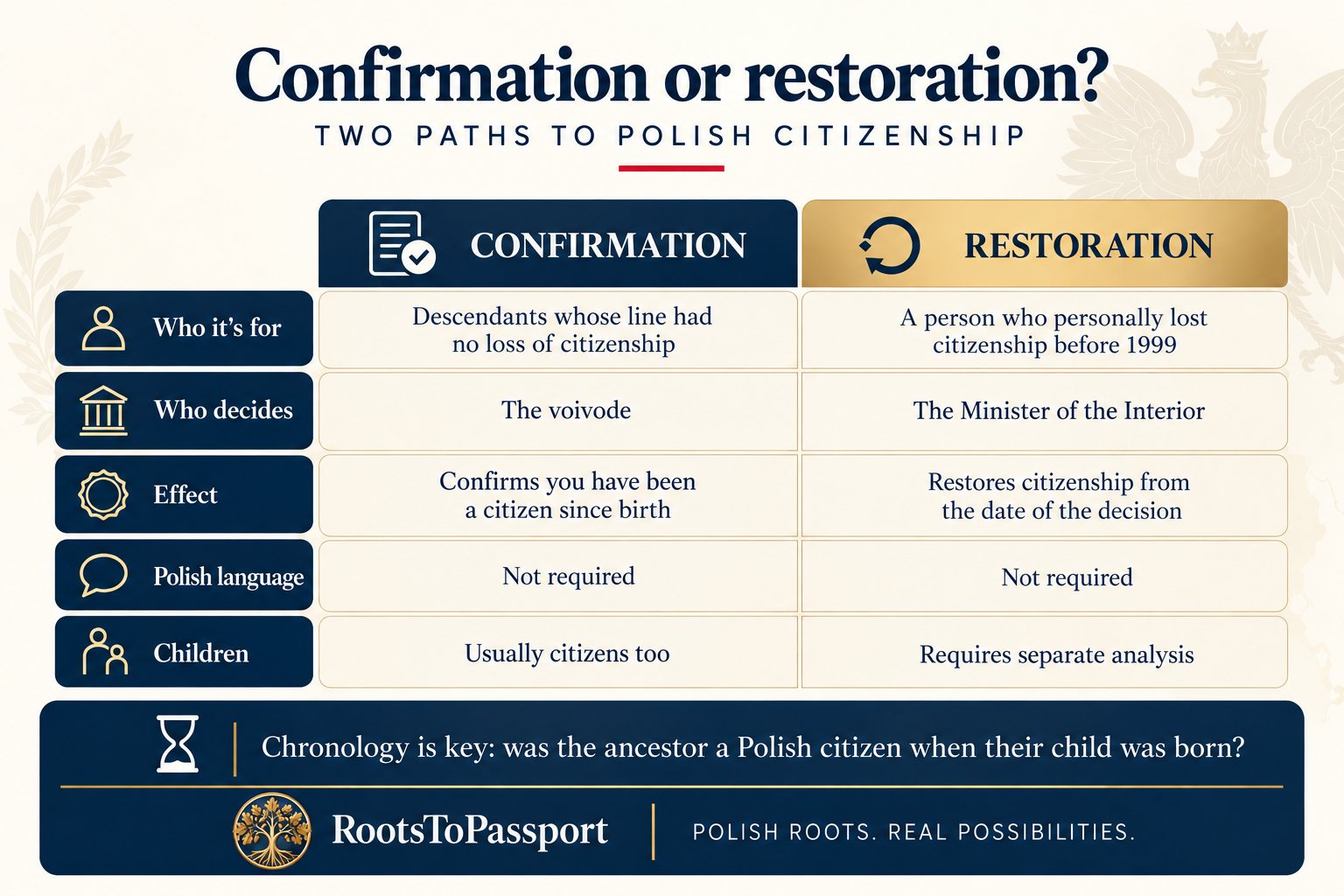
Comparison at a glance
| Confirmation | Restoration | |
|---|---|---|
| Who it's for | Descendants whose line never lost citizenship | A person who personally lost citizenship before 1999 |
| Authority | Voivode | Minister of the Interior |
| Effect | Confirms you have been a citizen since birth | Restores citizenship from the date of the decision |
| Polish language | Not required | Not required |
| Children | Usually citizens too | Needs separate analysis |
How can you tell which path applies to you?
Chronology is key. For each generation we check whether the ancestor was a Polish citizen when their child was born — and, if they acquired foreign citizenship before 1951, also whether the child was still a minor at that time. Three simplified examples:
Example A. The grandfather left Poland in 1930, the father was born in the USA in 1935, and the grandfather became a US citizen only in 1953, i.e. after 19 January 1951. From that date naturalization no longer caused the loss of Polish citizenship, so citizenship passed to the father and on down the line. This is a typical confirmation case.
Example B. The same grandfather was naturalized as early as 1932, i.e. before the father was born. In that case it must be carefully examined whether the naturalization actually caused the loss — the laws of that period contained exceptions, including for men subject to compulsory military service. Such a case is not lost from the outset, but it requires analysis.
Example C. The same grandfather became a US citizen in 1941, when the father was 6 years old. If the grandfather lost Polish citizenship at that point, the loss would, as a rule, also extend to his minor son. Here, too, the military-service exception may be decisive — if the grandfather did not lose citizenship, neither did the father. Such a case also requires analysis.
If you don't know which way your case will go, that's normal. Establishing this is the first step we take with every enquiry.
This article is for information only and does not constitute legal advice. The law is stated as of the date of publication. Every case requires an individual review of the documents.