Polish Roots #1: The Letter
The King Edward cigar box sat in her father's closet, behind a carton of winter hats. Emily didn't take it down until the second week after the funeral, when she came to clean out the house on Polish Hill in Pittsburgh before the sale.
Inside were a photograph of a young man in a jacket, a faded booklet with an eagle on the cover, and an envelope addressed in a careful, slanting hand, in Polish. Below the words "Do Mamy" was the name of a village: Lutoryż. Emily tried to say it out loud, and every time it came out differently.
Józef was her grandfather. She barely remembered him, because he died when she was four. She knew him only from her father's stories: that he had worked at the steel mill in Homestead, that he sang in Polish when he thought no one could hear, and that he never went back to Poland.
In the spring of 1923 he was nineteen. His mother walked him all the way past the last cottage of their village near Rzeszów. She pressed into his pocket a piece of bread wrapped in a linen cloth and a small medal of Our Lady of Leżajsk.
"Write, Józek. Write every month."
"I will. Once I've earned enough, I'll come back for you, Mama."
The ship from Hamburg, then New York, then a train, of which he remembered only that he was afraid to fall asleep in case someone stole his boots. At the mill he got work at the furnace, twelve hours a day, sometimes more. He sent almost all of his first pay home.
It was the neighbor, Rozalia, who wrote back, because his mother had never learned her letters, but at the end of every one she drew, in her own hand, a crooked little cross. Józef kissed those crosses.
He met Helena at a dance in St. Stanislaus Kostka parish. In 1934 their son Staś was born. At school they promptly turned him into Stanley, and Stanley he stayed. Every year Józef said that next year they would go to Poland. But there was the Depression, then the mill was laying men off, then there was the house to pay off.
In late August 1939 he wrote the most important letter of his life. Into the envelope he slipped a photograph of five-year-old Staś in a sailor suit: "Mama, this is your grandson. He has your eyes. We'll come in the spring, all three of us. This time for certain."
When he took it to the post office a few days later, the war in Poland had already begun. They told him mail to Poland was no longer getting through.
He put the letter away in the box. He thought it would be for a few months.
The news came only in 1946, from Rozalia. His mother had died in 1942. To the very end she kept asking whether Józek had written.
He never returned to his homeland. He became an American citizen in 1955, long after all his friends from the mill. He never threw away his Polish passport. He used to say that America gave him bread, but Poland gave him his name.
Emily opened the envelope. A small photograph slid out: a little boy in a sailor suit, with her father's eyes. With the eyes of her great-grandmother, whom none of them had ever met.
For a long time she couldn't read the letter. The only Polish she knew was "smacznego" and "sto lat." That evening she typed it into a translation app on her phone, letter by letter. When she reached the line about the eyes, she put the phone down on the table.
The next day she called her daughter.
"Remember how you asked where your great-grandfather came from? I think it's time we finally found out."
The plane touched down at Warsaw's Okęcie airport early in the morning, while the sky was still the color of steel. Emily woke when her daughter nudged her shoulder.
"Mom. We're here."
More than a year had passed since that phone call. A year of emails, old papers, and one afternoon when a photo of an entry in the parish register of Lutoryż landed in her inbox: Józef, son of Marianna and Tomasz, 1904. Emily read it three times before she understood that it really was him. The rest — who found it, where and how — she would tell many times afterwards, but that morning all that mattered was that they were driving to the village her grandfather had left.
Outside the car window, Poland looked different from what she had imagined. The fields were the color of honey, and poplars lined the road. Somewhere past Rzeszów they crossed a river so narrow you could have jumped over it, and a stork stood in the reeds without so much as turning its head. Through the half-open window came the smell of cut grass and of something sweet that Emily couldn't name, and that still seemed familiar.
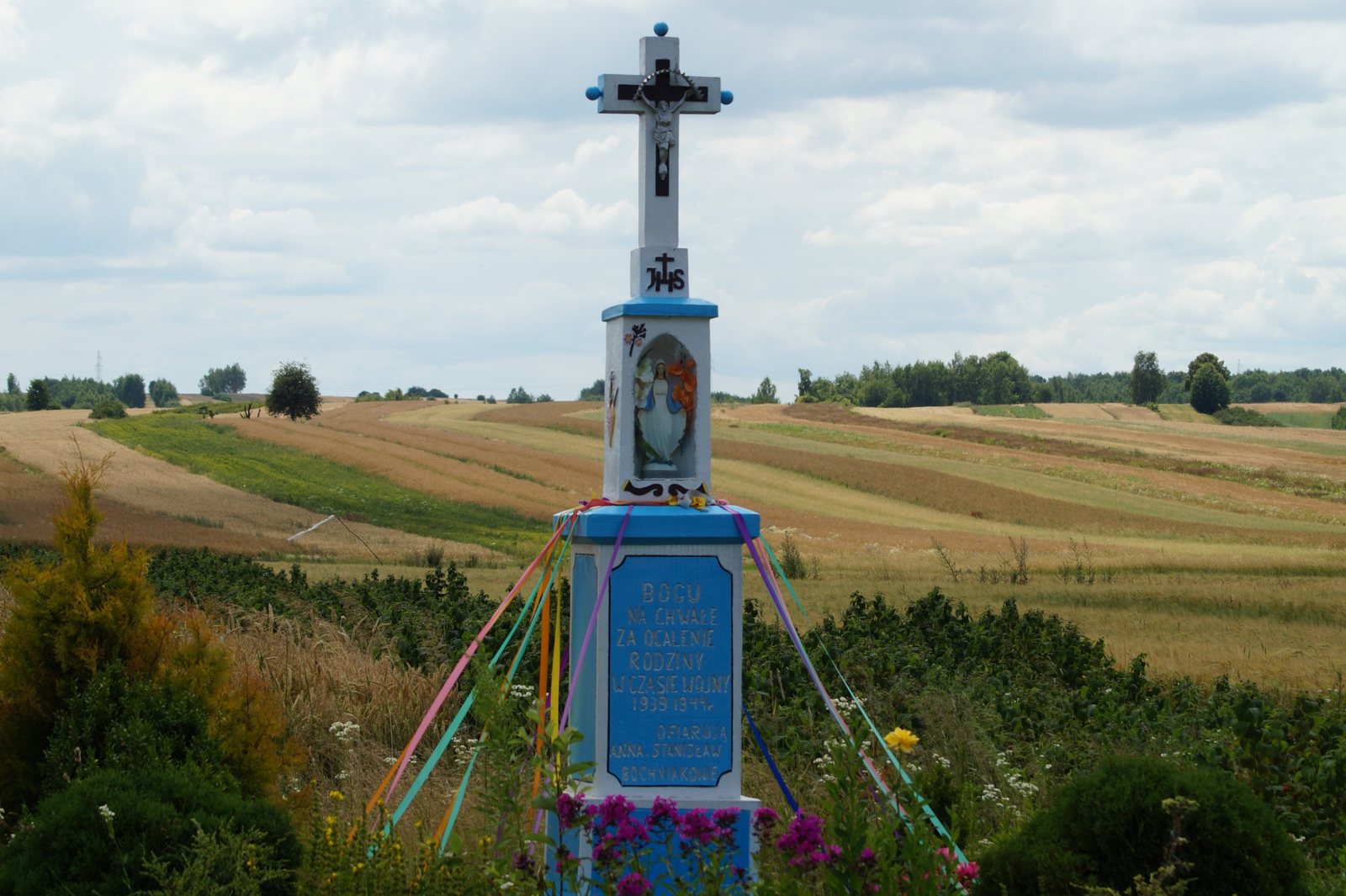
At the edge of Lutoryż a man was waiting for them. When Emily had written to him, he had answered simply: "The house is still standing. Come and see for yourselves." His name was Edward, and he turned out to be a relative of the same Rozalia who had once written letters for Marianna, who could not write.
The house stood at the end of a dirt road, smaller than in the photo Edward had sent. Wooden, roofed now with sheet metal, with a porch added probably in the seventies. But the same linden tree grew by the fence, enormous, and surely already big when nineteen-year-old Józef walked past it for the last time. Under the tree it was cool even on a sunny afternoon, and when the wind stirred the branches, it smelled of honey. It was the smell from the road.
"Grandma always said that the one who went to America learned to write here as a boy, under this linden," Edward said. "It was dark in the cottage, so he sat out here."
Emily sat down on the grass. She took the envelope out of her bag — the same yellowed envelope from 1939, addressed in a slanting hand: "Do Mamy." She hadn't opened it since the evening she typed the letter, letter by letter, into the translation app on her phone. She took out the letter and the photo of Staś. She laid the photo on the grass beside her, where Józef used to sit.
She read the letter aloud. In Polish, in her clumsy accent, stopping at every word as if she were afraid of getting something wrong. Her daughter stood beside her with a hand on her shoulder, looking out at the field beyond the fence.
She reached the line about Staś's eyes. Her voice broke, but she didn't stop.
"We'll come in the spring, all three of us. This time for certain."
The spring lasted almost ninety years. But the letter arrived — under the same tree, to the same soil, if not into the same hands.
That evening, in the kitchen of the house next door, at a table full of people she hadn't known a week earlier, Edward set an old photograph in a cardboard frame in front of her. A woman in a headscarf, her hands folded on her apron.
"Marianna," he said. "Józek once sent dollars so she could go to the photographer. It's the only one left."
Emily took out the photo of Staś and laid it beside hers. The table went quiet. Someone leaned in closer. The same eyes.
Then someone set a plate of pierogi in front of her and said only, "Smacznego, kuzynko."
"Smacznego," she answered without thinking. One of the two Polish words she had known since childhood.