Loss of Polish citizenship before 1951: when could an ancestor have lost it?
In Polish citizenship confirmation cases, one date comes up more often than any other: 19 January 1951. It determines whether an ancestor's emigration, naturalization or marriage could have broken the transmission of Polish citizenship. Here is why.
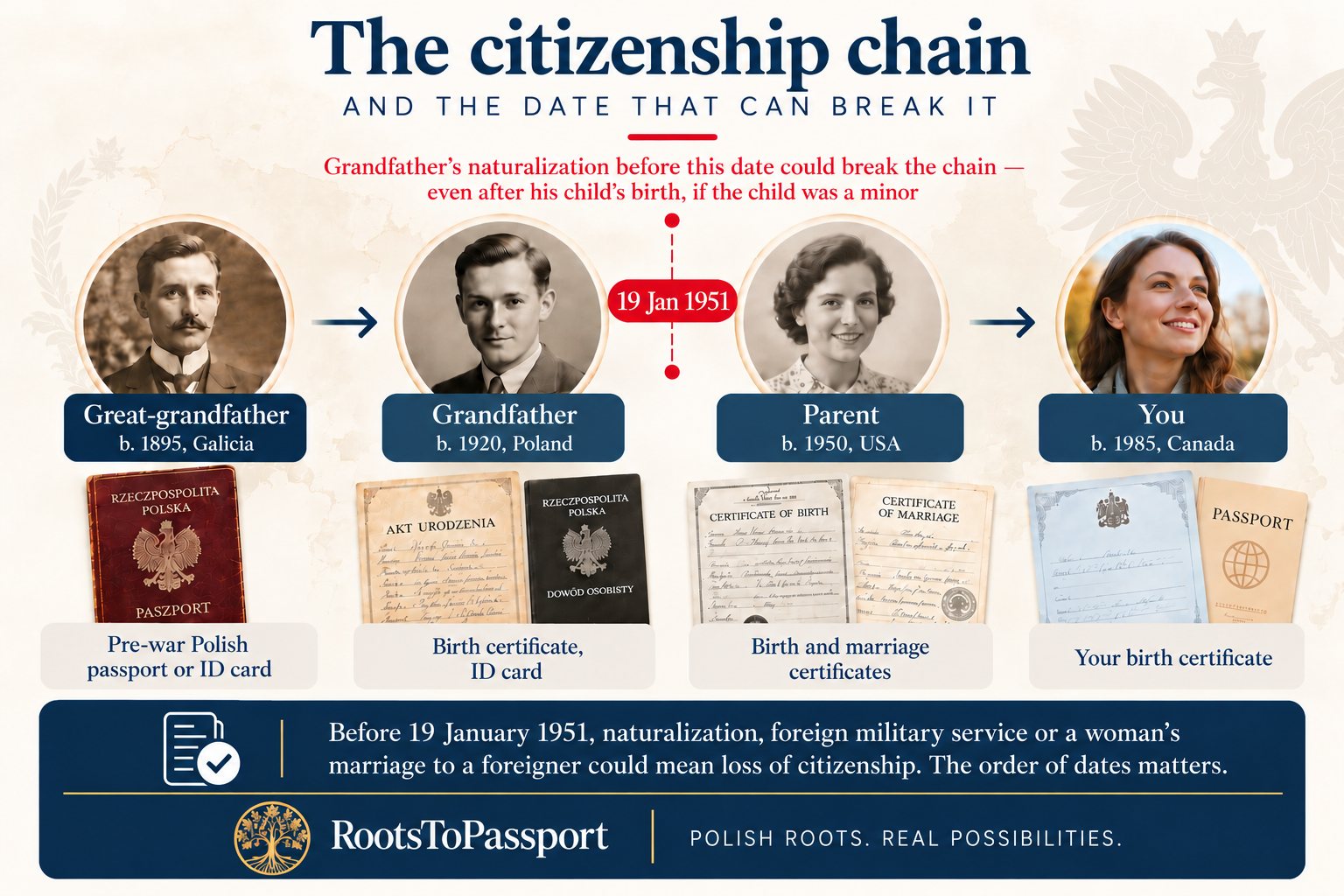
Why 19 January 1951?
On that day the Act of 8 January 1951 on Polish Citizenship came into force. Until then, the Act of 20 January 1920 on the Citizenship of the Polish State applied, which provided for loss of citizenship by operation of law — without any official decision and often without the person concerned even knowing.
That is why the first step in every case is to establish which events in your ancestors' lives took place before that date and which after it.
When could citizenship be lost before 1951?
The 1920 Act listed several situations that, as a rule, led to the loss of Polish citizenship:
- acquiring foreign citizenship, e.g. naturalization in the USA, Canada, Argentina or France,
- accepting public office in a foreign state without permission from the Polish authorities,
- joining the military service of a foreign state without the consent of the Polish authorities,
- for women — marrying a foreigner; under the rule of the time, a wife shared her husband's citizenship.
The loss did not affect only the ancestor himself. Under Article 13 of the 1920 Act, the loss of citizenship by a husband and father, as a rule, extended to his wife and to his children under 18, unless the Minister of the Interior decided otherwise.
The same principle governed how children acquired citizenship: before 1951, a child born in wedlock as a rule acquired the father's citizenship, and a child born out of wedlock the mother's. In practice, this means that for births before 1951 the male line often matters.
It is not automatic. Each of these points has nuances
The mere presence of one of these events does not settle the case. A few examples:
Naturalization
The order of dates matters — and so does the children's age. If the ancestor acquired foreign citizenship before his child was born, the child as a rule did not acquire Polish citizenship. If naturalization took place after the child's birth, but before 19 January 1951 and before the child turned 18, the loss could also extend to the child. The safe scenarios are those where the ancestor acquired foreign citizenship only after 19 January 1951, or when his child was already an adult.
In addition, the 1920 Act contained a reservation concerning men subject to compulsory military service, which in some cases limits the effects of naturalization. Whether it applies depends on the ancestor's age, the dates and the documents. If, for this reason, the ancestor did not lose his citizenship, his children did not lose it either.
Military service
Not every service in uniform counted as “service in a foreign army”. The Polish Armed Forces in the West, including General Anders' Army, were a Polish army. For transitional formations, forced conscription or service in the armed forces of other states before 1951, the case law of the administrative courts varies, and the outcome depends on the details: the date, the circumstances of enlistment and the content of the documents. Such cases require careful argument, but you should not assume in advance that they are lost.
A woman's marriage to a foreigner
Here, too, what matters is the date and the husband's citizenship at the time of the wedding. If the husband was himself a Polish citizen at the time, the problem does not arise at all — even if he emigrated later.
What about after 1951?
From 19 January 1951, acquiring foreign citizenship no longer caused the loss of Polish citizenship by itself. Loss was in principle possible only on the basis of formal permission to change citizenship, or as a result of being deprived of citizenship. Permission granted to parents extended to children under their parental authority (older children — with their consent). In practice this affected many people who emigrated from communist Poland, including some emigrants to Israel and those who left after March 1968. In such situations the right path may be restoration of citizenship, and sometimes also challenging the effect of the loss itself.
In short: events before 19 January 1951 could lead to loss by operation of law — including for children who were minors when their father lost citizenship — but each of them has exceptions and nuances. Later events as a rule do no harm, unless the ancestor obtained formal permission to change citizenship or was deprived of it.
How can you check your situation?
Gather what you know: the birth dates of each generation, dates of emigration and naturalization, information about marriages and any military service. You don't need documents for everything — even approximate dates allow us to make an initial assessment of whether citizenship may have been lost in your line and whether anything can be done about it.
This article is for information only and does not constitute legal advice. The law is stated as of the date of publication. Every case requires an individual review of the documents.